Real Betis arrive in Dortmund with a perfect Champions League record and a chance to test whether Borussia Dortmund can turn a difficult campaign around. Betis have beaten Lille, Porto and Feyenoord in their first three matches, while Dortmund sit 16th in the league phase table. That contrast gives the game a clear shape: the visitors have started with momentum, while the hosts need points and a more convincing European display. After the intensity of Der Klassiker, Dortmund will have to show they can reset quickly against a side already making a strong case for a top-eight finish.
Three wins make Betis’s start difficult to dismiss as a lucky run, though the next test is different. Playing away in Dortmund asks them to manage pressure as well as create chances, and a strong league-phase position is built across several matches, not one headline result. For Dortmund, the table position adds urgency, but it doesn’t tell the whole story of how they’ll perform on the night. The match is a test of whether Betis can carry their form into a demanding away setting and whether Dortmund can turn home support into control.
Betis have momentum, but the trip is a test
Betis earned their Champions League place through LaLiga’s European Performance Spot and have looked at home in the competition despite returning after a 21-year absence. That return gives their unbeaten start added meaning: they’re not simply trying to make up the numbers, but showing they can compete with established opponents. Manuel Pellegrini’s team are also fourth in Spain with 23 points, four behind third-placed Real Madrid. The domestic position suggests a side with more than one route to a successful season, though it also means European travel and league demands must be managed together.
Their form gives this fixture real weight. A win in Dortmund would be a significant marker of their ambitions, while even a draw would preserve the sense that Betis can handle a high-profile away game. This is more significant than it looks: for a team returning to the competition after a long absence, results against well-known opponents can shape expectations as much as the table does. Still, three victories don’t settle the question of how Betis will respond when an opponent dictates the pace.
Bartra’s return and Betis’s attacking focal point
Marc Bartra’s return adds a personal thread to the matchup. The 35-year-old defender spent a season and a half at Dortmund before joining Betis, where he became a popular figure among supporters. He’s expected to start in the visitors’ defense and has scored four goals this season. His previous connection with the club may make the occasion more familiar, but the practical task is less sentimental: help Betis withstand Dortmund’s attacks and keep their shape when the game opens up.

Bartra’s four goals also underline a useful secondary feature of Betis’s attack: defenders can contribute when the situation allows it. That doesn’t make him the central threat, but Dortmund will need to account for his presence on set pieces and in forward movement. (And this is the part most people overlook.) A defender’s threat at the other end can force an opponent to divide attention, especially when the match is tight.
Isco carries the creative burden
With Cucho Hernández injured, Isco is Betis’s primary attacking outlet. The 34-year-old captain operates behind Troy Parrott, drifting across the pitch to create chances and challenge Dortmund’s midfield. He has two goals and an assist in this Champions League campaign. That production gives Betis a clear creative reference point, though it also makes Isco’s availability of space a key part of the contest.

Isco’s role is less about staying in one channel than finding room between Dortmund’s lines and linking midfield to Parrott. If Dortmund crowd him out, Betis may have to rely more on movement from elsewhere; if he receives the ball facing forward, the visitors can make the hosts defend while turning toward their own goal. What this means for you as a viewer is simple: watch how quickly Dortmund close the space around Isco after Betis recover possession. That small battle could determine whether Betis build attacks patiently or have to settle for hurried forward balls.
There’s a clear dependency here. Cucho Hernández’s injury leaves more creative responsibility with the captain, so Betis need Isco to influence the game without making every attack predictable. The numbers here are underwhelming as a measure of the whole system—two goals and an assist capture output, but not the work involved in finding pockets of space or drawing defenders away from Parrott. Dortmund’s midfield has an opportunity to disrupt that rhythm.
Dortmund’s likely shape and the match call
Dortmund used a back four for long stretches against Bayern, with Gadou positioned as a defensive right-back. The expected adjustment is a return to a three-man defense: Schlotterbeck, Anton and Gadou. Ryerson and Svensson should occupy the flanks, with Jobe and Veerman in midfield. Karetsas is projected to create behind Silva and Guirassy. Those roles suggest a setup intended to give Dortmund width while keeping three defenders behind the play, though the listed shape is a forecast, not a guarantee of how the team will line up once the match begins.
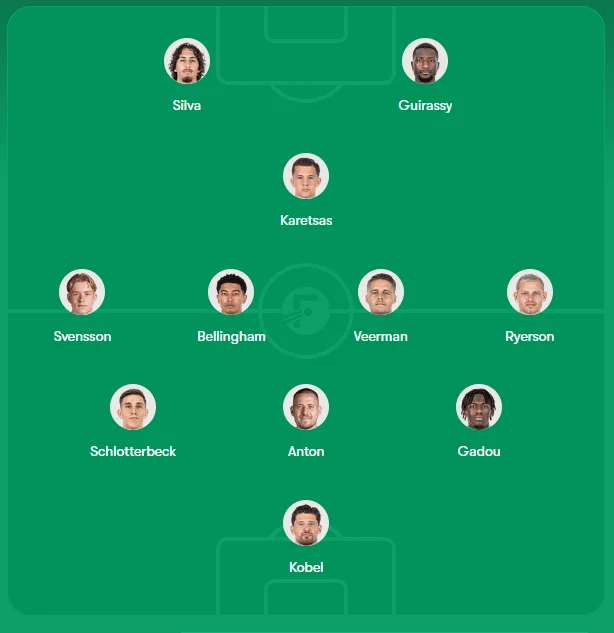
The choice to move back to three central defenders would change the balance from the Bayern match. Flank players may have more responsibility for advancing the ball, while the midfield pairing must protect the space in front of the defense and connect attacks. If that structure holds, Dortmund could press with numbers while retaining cover behind the ball. If Betis find a way to move through the middle, however, the same arrangement could leave the wing-backs choosing between tracking runners and supporting the attack.
A 2-2 draw looks plausible. Dortmund could take a two-goal lead, buoyed by home support, then struggle to contain Betis late on. That call rests on two competing readings of the game: Dortmund have the home advantage and a reason to respond after Der Klassiker, while Betis bring an unbeaten European start and an attack organized around Isco. The hosts’ response to the Bayern draw may decide whether they control the match or leave room for the visitors to punish them.
What the result could tell us
For Betis, the match is a chance to show that their first three wins can translate into a result under pressure away from home. For Dortmund, it’s an opportunity to prove that a difficult league-phase position can be met with a disciplined performance, rather than another uneven display. Neither outcome would settle the broader campaign, but the way each side handles momentum could offer a useful measure of its current strengths.
If you’re working in this space, the tactical details are worth watching alongside the result: Dortmund’s defensive shape, Betis’s ability to find Isco, and whether the visitors can keep their composure if the hosts start quickly. A late Betis response is plausible, but it depends on Dortmund giving them openings and the visitors making good use of them. The match may turn on a few transitions.